
Understanding Your Unified Score
The Unified Score tells you how well your design performs at its intended job, based on where real attention goes — not opinion.
The Score and Bands
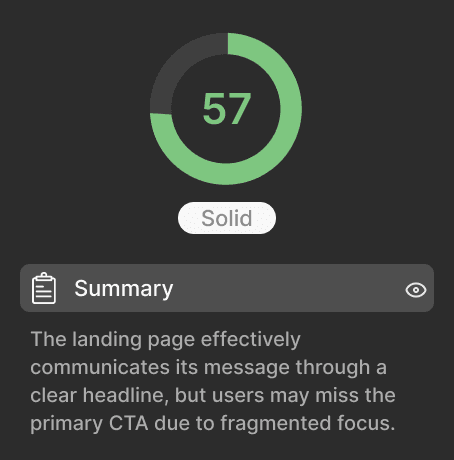
Your score is a number from 0–100. It maps to one of four bands:
| Band | What it means |
|---|---|
| Needs work | Significant friction present. Users are likely missing key elements or struggling to process the design. |
| Solid | The design is functional but has clear opportunities. One or two targeted changes could meaningfully improve performance. |
| Strong | The design is working well. Risks identified are real but unlikely to block most users. |
| Excellent | High performance across all dimensions. Focus on preserving what's working when iterating. |
The score is relative to your stated intent — a 72 on a convert goal means something different from a 72 on a stop scrollgoal. Don’t compare scores across different intent settings.
The Five Dimensions
Your score is built from five subscores (0–100 each), each measuring a distinct aspect of design performance.
Message Clarity
Can users quickly understand what this is and why it matters? Low scores typically mean the headline isn’t registering before other elements draw attention away, or the visual hierarchy doesn’t support the order in which information needs to land.
Focus & Guidance
Does the design lead the eye where it needs to go? A high score means there’s a clear path from entry point to CTA. A low score often indicates competing focal points — multiple elements pulling attention equally, leaving users without a clear next step.
First-3-Seconds Readiness
How strong is the immediate impression? This measures what a user takes away before they’ve consciously processed anything. Critical for ads and top-of-funnel creative; less critical for long-form pages where users have committed to reading.
Cognitive Load
How much mental effort is required? This dimension is penalty-based — a lower score means the design is asking users to work harder than they should. Dense layouts, competing type scales, and busy backgrounds all raise cognitive load.
Goal Fit
Does attention land where it needs to for the design’s specific purpose? A design can communicate clearly and still direct attention to the wrong places. Goal Fit measures whether where eyes go actually supports what the design is trying to achieve.
Why Intent Affects Your Score
When you set a creative intent, the weights applied to each dimension shift to reflect what matters most for that goal.
| Intent | What’s weighted most heavily |
|---|---|
| Stop scroll | First-3-Seconds Readiness, Focus & Guidance |
| Inform fast | Message Clarity |
| Convert | Message Clarity, Focus & Guidance |
| Reassure trust | Message Clarity, Cognitive Load |
| Brand recall | Goal Fit, First-3-Seconds Readiness |
| Compare & decide | Goal Fit, Cognitive Load |
If you’re unsure which intent fits your design, choose the one that best describes the single action or outcome you most want from a user.
Reading Your Results
Verdict
A one-sentence summary of overall performance and the primary limiting factor, tied to a specific element in your design. This is the fastest way to understand the headline finding.
What’s working well
Up to three things the design is doing right, each tied to a specific visual element. When iterating, these are the things to preserve.
Top risks
Three user failure modes — behaviours that are likely happening right now. Each risk describes what users are doing (or not doing) as a result of a specific design issue.
Recommendations
Three suggested changes, each directly addressing one of the listed risks. Each recommendation tells you what element to change, how to change it, and what user behaviour should improve. Start with the recommendation that addresses your highest-priority risk.
Tips
- —Run the score early, not just at the end. The score is most useful when you still have time to act on it.
- —Re-run after significant changes. Track the delta across iterations to confirm changes are moving in the right direction.
- —If a recommendation conflicts with a constraint, focus on the expected impact — there may be another way to achieve the same outcome within your constraints.